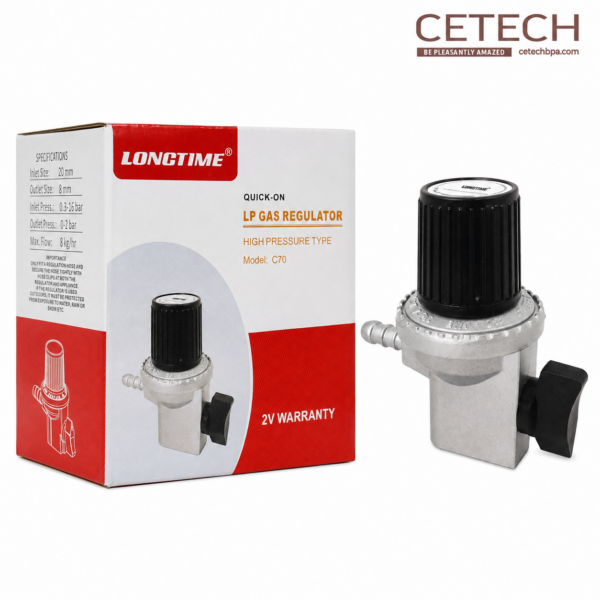


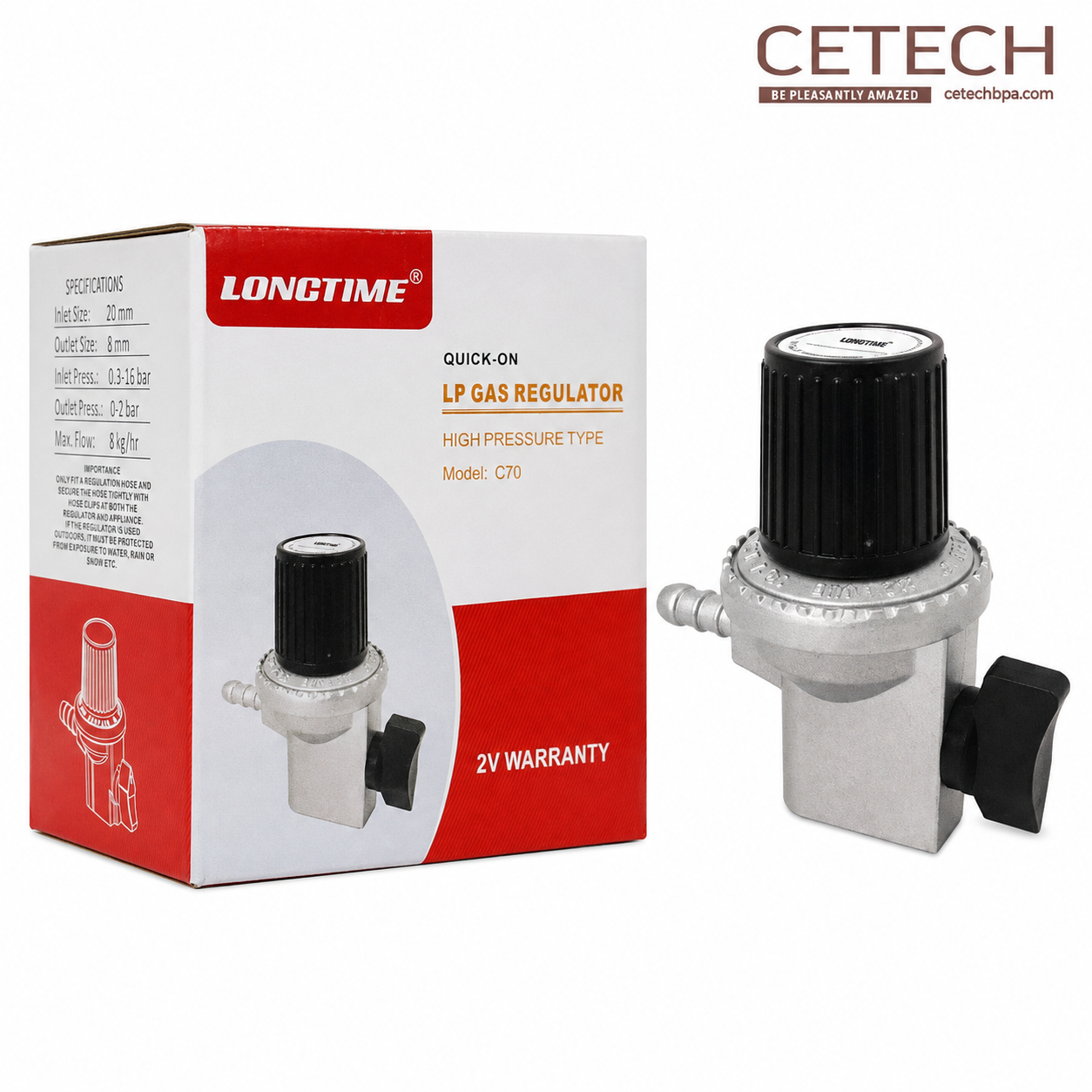


LONGTIME LP HIGH PRESSURE GAS REGULATOR QUICK-ON (C70) – High Pressure LPG Gas Regulator for Controlled Gas Flow
The LONGTIME LP High Pressure Gas Regulator Quick-On, Model C70 is a high pressure LPG gas regulator designed to control gas pressure and flow from a compatible LPG cylinder to connected equipment. It has a 20mm inlet, 8mm outlet, 0.3–16 bar inlet pressure range, 0–2 bar outlet pressure range, and maximum flow of 8 kg/hr, making it suitable for LPG applications that require controlled and adjustable gas delivery
For customers searching for a gas regulator, high pressure gas regulator, LPG gas regulator, LPG regulator, high pressure LPG regulator, gas regulator valve, or gas regulator price in Ghana, the LONGTIME C70 provides a clearly specified option for applications where a high-pressure regulator is appropriate.
What Is the LONGTIME C70 Gas Regulator?
A gas regulator is a component used in an LPG gas system to control the pressure and flow of gas between the cylinder and the connected appliance or equipment.
The LONGTIME C70 is specifically identified as a high pressure type and features a Quick-On connection and an integrated switch for controlling gas flow. Its outlet pressure specification is 0–2 bar, while its maximum stated flow is 8 kg/hr.
This makes the C70 different from a conventional fixed low pressure domestic regulator. Buyers should select a regulator according to the pressure and flow requirements of the appliance or gas system rather than choosing a regulator simply because it fits the cylinder.
The manufacturer identifies the C70/E70 family as a high-pressure LP gas regulator with a 20mm inlet option and 8mm outlet. (Ningbo Gas Control)
Key Product Specifications
Technical Specifications
| Specification | LONGTIME C70 |
|---|---|
| Brand | LONGTIME |
| Product Type | LP High Pressure Gas Regulator |
| Connection Type | Quick-On |
| Model | C70 |
| Regulator Type | High Pressure |
| Inlet Size | 20mm |
| Outlet Size | 8mm |
| Inlet Pressure | 0.3–16 bar |
| Outlet Pressure | 0–2 bar |
| Maximum Flow | 8 kg/hr |
These specifications are important when determining whether the regulator is appropriate for a particular LPG cylinder, hose, appliance, burner, or other gas equipment.
The C70 product information available from the manufacturer also lists an 8mm outlet and a 0–2 bar outlet-pressure range. (Ningbo Gas Control)
Understanding the C70 Pressure Specifications
Inlet Pressure: 0.3–16 Bar
The stated inlet pressure range is 0.3–16 bar. This describes the pressure range of gas entering the regulator under the specified product conditions.
The regulator receives gas from the LPG cylinder and controls the gas delivered through its outlet. The actual operating pressure required by downstream equipment should always be considered before installation.
Outlet Pressure: 0–2 Bar
The C70 has a stated 0–2 bar outlet pressure range.
This is an important specification because not every LPG appliance is designed to operate at the same gas pressure. A high pressure regulator should therefore not automatically be substituted for a low pressure regulator.
If you are uncertain about the pressure requirement of an appliance or burner, confirm the equipment manufacturer’s requirements or consult a qualified gas technician before installation.
Maximum Flow: 8 kg/hr
The maximum stated flow rate is 8 kg/hr.
Flow capacity matters when selecting a regulator for equipment that consumes significant quantities of LPG. A regulator must be suitable for the expected gas demand of the connected equipment.
A regulator with an inappropriate flow capacity may not be suitable for a high-demand application, even if its physical connection appears compatible.
Main Features of the LONGTIME C70
High Pressure LPG Regulation
The LONGTIME C70 is designed as a high pressure gas regulator, making it appropriate for LPG systems that specifically require high-pressure gas regulation.
This distinguishes it from low pressure LPG regulators commonly used with appliances designed for lower operating pressures.
Quick-On Connection
The C70 uses a Quick-On connection system. This provides a convenient way of connecting and disconnecting the regulator from a compatible cylinder valve.
The connection must always be properly engaged and secured before gas is turned on.
Integrated Gas Control Switch
The regulator incorporates a switch for controlling the gas supply.
According to the supplied operating instructions:
- The switch points downward before installation.
- After placing the regulator on the cylinder valve, turn the switch clockwise so that it points to the left, the stated “OFF” position.
- To turn the gas ON, turn the switch clockwise.
- To turn the gas OFF, turn the switch anti-clockwise until it points to the left.
- For disconnection, turn the switch anti-clockwise from the OFF position until it points downward.
- Remove the regulator from the cylinder and replace the cylinder valve’s plastic cap.
Always follow the product instructions and use appropriate gas-system installation practices.
20mm Inlet
The C70 supplied specification includes a 20mm inlet size.
This is one of the most important details to check before purchasing because LPG cylinder valve connections are not universally interchangeable.
Do not assume that every 20mm-looking connection is automatically compatible. Confirm the cylinder valve and regulator connection before installation.
8mm Outlet
The regulator has an 8mm outlet.
The supplied instructions specifically require a regulation hose and state that the hose should be secured tightly with hose clips at both the regulator and appliance.
The hose therefore needs to be suitable for the LPG system and compatible with the regulator’s 8mm outlet.
Who Is the LONGTIME C70 For?
The LONGTIME C70 may be considered by buyers who specifically require a high pressure LPG gas regulator with the stated pressure and flow characteristics.
Potential users include:
- Commercial LPG users
- Technicians and gas-system installers
- Contractors
- Workshops using compatible LPG equipment
- Commercial kitchens requiring compatible high-pressure gas systems
- Food-processing operations using compatible LPG equipment
- Businesses replacing an existing compatible high-pressure regulator
- Industrial and commercial buyers sourcing LPG system components
- Institutions with compatible LPG equipment
- Customers requiring replacement LPG regulator components
The suitability of the C70 depends on the requirements of the downstream equipment. It should not be selected solely because it is marketed as a high pressure regulator.
Commercial and Industrial LPG Applications
Commercial Kitchens
Restaurants, catering operations, food businesses, hotels and other commercial kitchens can have substantially different LPG requirements from a typical household stove.
Where an appliance or burner specifically requires high-pressure LPG regulation and falls within the C70’s specified pressure and flow characteristics, the regulator may be considered as part of the gas system.
Manufacturing and Processing
Some manufacturing and processing environments use LPG for heating, burners or other compatible equipment.
For these applications, buyers should evaluate the entire gas system, including cylinder or supply source, regulator, hose, valves, appliance and required operating pressure.
Workshops and Contractors
Technicians and contractors may require LPG regulators when installing, maintaining or replacing components in compatible gas systems.
The C70 model number, 20mm inlet, 8mm outlet, 0–2 bar outlet range and 8 kg/hr maximum flow provide useful information for checking compatibility before procurement.
Agriculture and Other Commercial Uses
LPG can be used in a variety of commercial environments, including selected agricultural and food-processing applications. The C70 should only be used where the connected equipment is designed for its specified gas pressure and flow conditions.
Home or Personal Use
The C70 should not automatically be treated as a standard household low pressure regulator.
Domestic LPG users should first determine the pressure requirement of their particular stove or appliance. A low pressure vs high pressure gas regulator comparison is particularly important before purchasing.
High Pressure Gas Regulator vs Low Pressure Gas Regulator
One of the most common buyer questions is the difference between a high pressure gas regulator and a low pressure gas regulator.
High Pressure Gas Regulator
A high pressure regulator is designed for gas systems requiring higher regulated outlet pressure than typical low-pressure domestic applications.
The LONGTIME C70 is specified as a high pressure type, with an outlet pressure range of 0–2 bar.
Low Pressure Gas Regulator
A low pressure gas regulator is designed for equipment requiring a lower regulated gas pressure.
Many ordinary domestic LPG cooking appliances use low-pressure regulation, but the correct pressure should always be determined from the appliance requirements.
Which One Should You Buy?
Do not choose between high pressure and low pressure based only on price, physical size or appearance.
Check:
- Required operating pressure.
- Required gas flow.
- Cylinder valve connection.
- Regulator inlet size.
- Hose connection size.
- Appliance manufacturer’s requirements.
- Whether the regulator is suitable for the intended LPG application.
If the equipment requires a low pressure regulator, the C70 high pressure model may not be the appropriate choice.
How to Connect the LONGTIME C70 to an LPG Cylinder
The supplied operating instructions provide a specific sequence for connecting and disconnecting the regulator.
Connecting the Regulator
Step 1: Position the Switch
Ensure the switch is pointing downwards before installing the regulator.
Step 2: Place the Regulator on the Cylinder Valve
Position the regulator correctly on the compatible cylinder valve.
Step 3: Set the Regulator to OFF
Turn the switch clockwise so that it points to the left, which is identified in the supplied instructions as the OFF position.
Step 4: Connect the Regulation Hose
Fit an appropriate regulation hose to the regulator outlet.
The supplied product instructions specifically state that the hose should be secured tightly using hose clips at both the regulator and appliance.
Step 5: Inspect the Connection
Before using the system, make sure the regulator, hose and appliance connections are correctly installed and secure.
Installation and inspection should be performed by a competent person where the user is not experienced with LPG equipment.
How to Turn the C70 Gas Regulator ON and OFF
Turning the Gas ON
Turn the switch clockwise so that the gas is ON.
Turning the Gas OFF
Turn the switch anti-clockwise until it points to the left.
Turning the gas supply off when the appliance is not being used is an important operating practice.
How to Remove the Gas Regulator From a Gas Bottle
The supplied instructions specify the following sequence:
- Put the gas supply in the OFF position.
- Turn the switch anti-clockwise until it points downward.
- Remove the regulator from the cylinder.
- Affix the plastic cap to the cylinder valve.
This procedure addresses the common search query “how to remove gas regulator from gas bottle” and “how to remove gas regulator from tube.”
Do not force a regulator off a cylinder connection. If a regulator does not release normally, seek assistance from a qualified gas technician or appropriate LPG service provider.
LPG Gas Regulator and Hose Installation
The regulator and hose work together as part of the LPG delivery system.
The C70’s supplied instructions state that users should:
- Use a regulation hose.
- Secure the hose tightly with hose clips at the regulator.
- Secure the hose tightly with hose clips at the appliance.
- Protect the regulator from outdoor exposure to water, rain or snow.
Correct hose selection is therefore just as important as choosing the regulator.
A suitable LPG regulator and hose combination should match the connection, pressure, gas type and application.
Important Safety Practices
LPG equipment should be handled carefully because leaks can create serious fire hazards.
Protect the Regulator From Outdoor Weather
The supplied instructions specifically state that if the regulator is used outdoors, it must be protected from exposure to water, rain or snow.
Outdoor installation should therefore include appropriate protection while ensuring that the regulator and gas system remain correctly installed and accessible for inspection.
Do Not Use Improvised Leak Solutions
The National Petroleum Authority of Ghana has warned against placing stones or other heavy objects on LPG cylinder regulators to stop leaks. The NPA advises replacing defective components with appropriate certified components through authorized LPG channels rather than using improvised methods. (NPA)
Inspect the Hose and Connections
A gas system should not be operated when the regulator, hose, clips, cylinder connection or other components show visible damage or abnormal conditions.
If you notice an unusual gas smell or persistent hissing sound from an LPG gas regulator, shut off the gas supply if it is safe to do so and have the system inspected by a qualified professional.
Common Mistakes to Avoid
Choosing the Wrong Regulator Pressure
One of the biggest mistakes is purchasing a high pressure regulator when the appliance requires low pressure regulation.
Always verify the appliance requirements first.
Ignoring the Connection Size
The C70 has a 20mm inlet and 8mm outlet. These dimensions should be checked against the cylinder connection and hose before purchase.
Using an Unsuitable Hose
Do not connect an unsuitable hose simply because it fits physically.
The hose must be appropriate for LPG service and properly secured.
Failing to Secure Hose Clips
The supplied instructions require hose clips at both the regulator and appliance connections.
A loose hose connection can create a serious gas-system problem.
Exposing the Regulator to Rain
Outdoor exposure without protection is specifically discouraged by the supplied instructions.
Modifying the Regulator
Avoid unauthorized modification of the regulator, including attempts to change its internal components or use an unsuitable adjustment screw.
If an application requires a different pressure range, select an appropriate regulator rather than modifying the C70.
Gas Regulator Adjustment and Adjustment Screws
Searches such as “LPG gas regulator adjustment,” “gas regulator adjustment screw,” and “how to use high pressure gas regulator” are common among LPG users.
The C70 is specified with an outlet pressure range of 0–2 bar, but users should not make adjustments without understanding the requirements of the connected appliance and gas system.
An adjustment mechanism should not be treated as permission to operate an appliance outside its specified pressure range.
For commercial, industrial or unfamiliar equipment, pressure verification and adjustment should be handled by an appropriately qualified technician.
What About Hissing Sounds From an LPG Gas Regulator?
A hissing sound from an LPG gas regulator should not simply be ignored.
A suspected gas leak may involve the regulator, hose, valve, connection, seal or another part of the LPG system. Ghana’s National Petroleum Authority has specifically noted that faulty hoses, valves and O-rings can be associated with LPG leaks. (NPA)
If you suspect a leak:
- Turn off the gas supply if it is safe to do so.
- Keep flames and ignition sources away.
- Do not attempt improvised repairs.
- Do not place stones or heavy objects on the regulator.
- Have the system inspected and defective components replaced appropriately.
Gas Regulator Types and Related Products
Customers comparing gas regulator types, types of gas regulator, or types of LPG regulator may encounter several categories.
These can include:
- High pressure LPG regulators
- Low pressure LPG regulators
- Single stage LPG regulators
- Fixed-pressure regulators
- Adjustable regulators
- Quick-On or snap-on regulators
- LPG regulators with gauges
- Regulators designed for specific LPG cylinder connections
- Industrial LPG regulators
- Propane regulators
- Specialized regulators for particular gas applications
Other brands and product families available in the wider LPG regulator market include Cavagna, Clesse, Rinnai and Kosangas, depending on the application and market availability.
However, brand recognition alone does not determine suitability. The regulator’s pressure range, connection, flow capacity and compatibility with the equipment are more important decision factors.
For example, a Cavagna LPG regulator, Clesse LPG regulator, Rinnai gas regulator, or Kosangas LPG regulator should not be substituted for the C70 simply because it is another recognized brand. The technical requirements must be compared first.
Similarly, products marketed as an LPG regulator adaptor for cylinder, LPG regulator screwfix, LPG regulator Bunnings, or other market-specific alternatives may have different connection standards and pressure characteristics.
Is the C70 Suitable for Welding?
Customers sometimes search for “gas regulator argon welding.”
The LONGTIME C70 is identified in the supplied product information as an LP high pressure gas regulator. It should therefore not automatically be used as an argon welding regulator.
Argon welding equipment requires a regulator specifically designed and specified for argon service. LPG regulators and welding-gas regulators should not be treated as interchangeable simply because both products control gas pressure.
How to Choose the Right LPG Regulator
Before purchasing an LPG regulator in Ghana, check the following:
1. Gas Type
Confirm that the regulator is suitable for the gas being used.
2. Required Pressure
Determine whether the equipment requires high pressure or low pressure regulation.
3. Inlet Connection
For the C70, the stated inlet size is 20mm.
4. Outlet Connection
The C70 has an 8mm outlet.
5. Flow Requirement
The C70 has a maximum stated flow of 8 kg/hr.
6. Cylinder Compatibility
Confirm that the regulator connection matches the cylinder valve.
7. Hose Compatibility
Use an appropriate regulation hose and secure it correctly with hose clips.
8. Application
Consider whether the regulator will be used for domestic, commercial, industrial, workshop or another compatible LPG application.
Why Choose the LONGTIME C70 From CETECH Ghana?
CETECH Ghana supplies the LONGTIME C70 to customers looking for LPG system components and gas-control products in Ghana.
The product is available for customers who need a gas regulator in Ghana, a high pressure gas regulator, or an LPG regulator for a compatible application.
CETECH Ghana serves a broad customer base, including:
- Individual customers
- Businesses
- Contractors
- Technicians
- Commercial buyers
- Institutions
- Industrial buyers
- Project procurement teams
Customers can purchase online or enquire about product availability and supply support.
CETECH Ghana’s online product listing identifies the LONGTIME Quick-On LP Gas Regulator Model C70 as a high-pressure LPG regulator with a 20mm inlet, 8mm outlet and maximum flow of 8 kg/hr. (CETECH Ghana)
Online Ordering and Offline Availability in Ghana
For customers searching for “high pressure gas regulator near me,” “gas regulator price in Ghana,” “gas regulator for sale in Ghana,” or an LPG regulator supplier in Ghana, CETECH Ghana provides an online purchasing option as well as physical-store and warehouse support.
Because stock quantities can change, customers requiring multiple units should confirm availability before travelling to a physical location.
CETECH Ghana also supports wholesale and retail purchasing, making it possible to source individual units or larger quantities depending on project requirements.
Bulk LPG Regulator Supply in Ghana
Contractors, businesses, institutions and project buyers may need multiple gas regulators for installations, replacement programs or equipment procurement.
For bulk purchasing, it is useful to provide:
- Required quantity
- Regulator model
- Intended application
- Cylinder connection information
- Required delivery location
- Required delivery timeframe
This helps the supplier confirm the appropriate product and available quantity.
For industrial sourcing, customers should also provide the required technical specifications so that the product can be evaluated against the application rather than purchased based only on appearance.
Product Value for Ghanaian Buyers
The LONGTIME C70 offers several practical advantages when its specifications match the intended application:
- High pressure LPG regulator design
- Quick-On connection
- 20mm inlet
- 8mm outlet
- 0.3–16 bar inlet pressure range
- 0–2 bar outlet pressure range
- Maximum flow of 8 kg/hr
- Integrated ON/OFF control
- Clearly defined technical specifications
- Suitable for compatible commercial and high-demand LPG applications
Its main limitation is equally important: it is not a universal regulator for every LPG appliance.
The pressure, flow, connection and application must match the equipment.
Frequently Asked Questions
What is the LONGTIME C70?
The LONGTIME C70 is a Quick-On LP high pressure gas regulator designed for controlled LPG gas delivery. Its stated specifications include a 20mm inlet, 8mm outlet, 0.3–16 bar inlet pressure, 0–2 bar outlet pressure and maximum flow of 8 kg/hr.
Is the LONGTIME C70 a high pressure gas regulator?
Yes. The product is identified as a high pressure type.
What is the inlet size of the C70?
The inlet size is 20mm.
What is the outlet size?
The outlet size is 8mm.
What is the maximum flow rate?
The maximum stated flow rate is 8 kg/hr.
What is the outlet pressure?
The stated outlet pressure range is 0–2 bar.
What is the inlet pressure?
The stated inlet pressure range is 0.3–16 bar.
Can the C70 be used with any gas cylinder?
No. The cylinder valve and regulator connection must be compatible. Confirm the cylinder connection before installation.
Can I use the C70 with a low-pressure stove?
Do not assume that it is suitable. The C70 is a high pressure regulator, so the stove or appliance must specifically be compatible with its required pressure and gas flow characteristics.
Can I use the C70 for argon welding?
It should not be assumed to be suitable. Argon welding requires equipment specifically designed for argon service.
How do I connect the C70 to a cylinder?
Follow the supplied operating instructions: position the switch downward, place the regulator on the compatible cylinder valve, set the switch to the stated OFF position, and connect a suitable regulation hose securely using hose clips.
How do I remove the regulator from a gas bottle?
Switch the gas OFF, turn the switch anti-clockwise until it points downward, remove the regulator, and affix the plastic cap to the cylinder valve.
What should I do if the regulator makes a hissing sound?
Treat an unexpected hissing sound as a potential gas-system problem. Shut off the gas supply if safe, keep ignition sources away and arrange for the system to be inspected by a competent person.
Should the C70 be protected from rain?
Yes. The supplied instructions state that if the regulator is used outdoors, it must be protected from water, rain, snow and similar exposure.
Can I buy the C70 in bulk?
Yes. CETECH Ghana serves retail and commercial customers and can support enquiries for multiple units, subject to available stock and project requirements.
LONGTIME C70 Buying Checklist
Before ordering the LONGTIME LP HIGH PRESSURE GAS REGULATOR QUICK-ON (C70), confirm:
- Brand: LONGTIME
- Model: C70
- Type: LP high pressure gas regulator
- Connection: Quick-On
- Inlet: 20mm
- Outlet: 8mm
- Inlet pressure: 0.3–16 bar
- Outlet pressure: 0–2 bar
- Maximum flow: 8 kg/hr
- Intended gas: LPG
- Appliance pressure requirement is compatible
- Cylinder valve is compatible
- Regulation hose is appropriate
- Hose clips can securely fasten the connections
- Outdoor installation will provide protection from water, rain and snow
The LONGTIME C70 High Pressure LPG Gas Regulator is a practical option for Ghanaian buyers who require a Quick-On LPG regulator with a 20mm inlet, 8mm outlet, 0–2 bar outlet pressure range and maximum flow of 8 kg/hr. The most important purchasing decision is compatibility: always match the regulator’s pressure, flow, connection and gas requirements with the equipment before installation. CETECH Ghana provides online and offline purchasing, retail and bulk sourcing support for customers seeking LPG regulators and related gas-system products in Ghana.